How Coursey Graves Built a Digital Marketing Engine That Drives Real Results
A recap of our Free Training Friday featuring Sue Wollan Fan and Maeve Smith of Coursey Graves Estate Winery
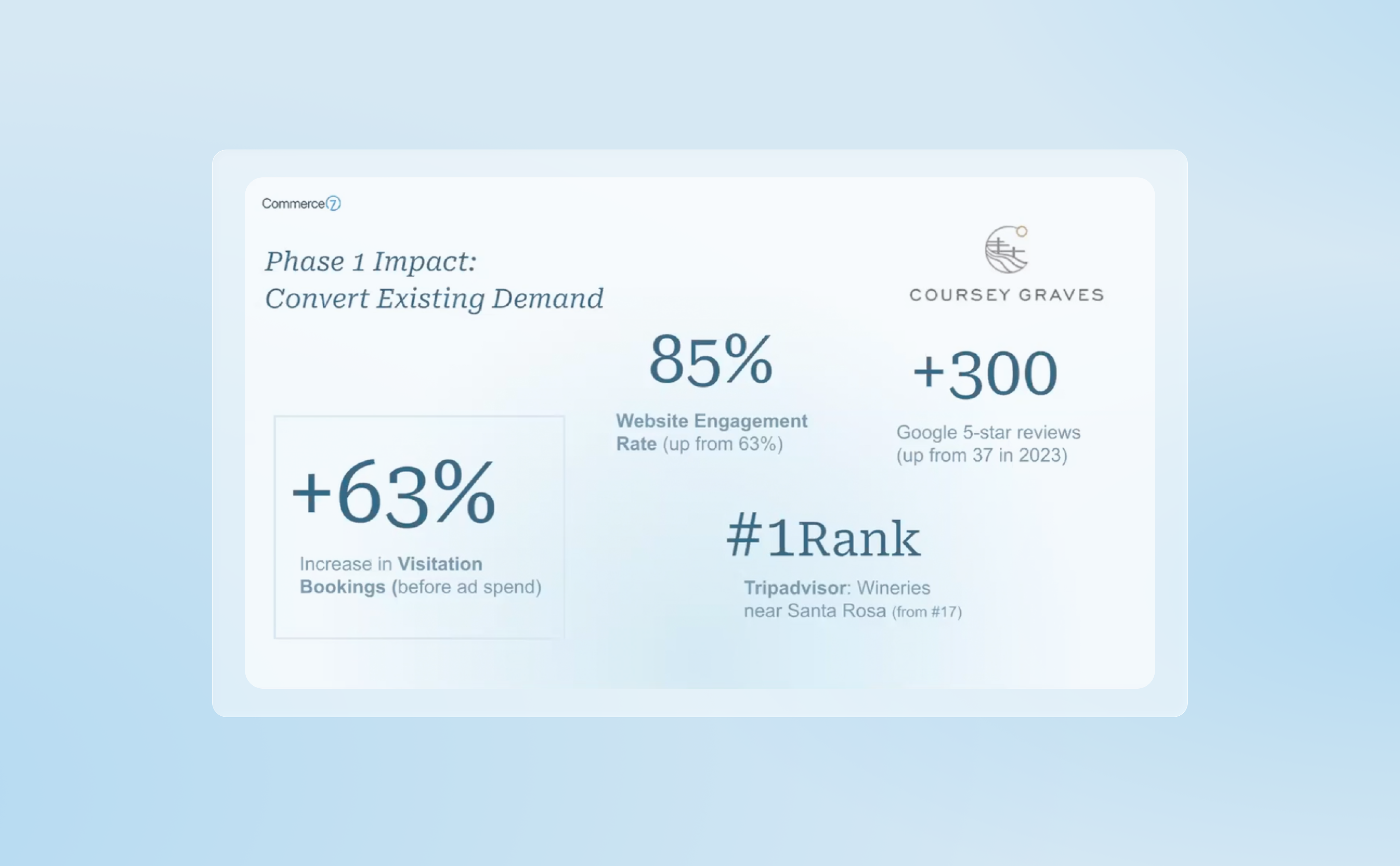
What does it actually look like when a boutique winery goes all-in on digital marketing and wins? In our most recent Free Training Friday, we sat down with Sue Wollan Fan, digital marketing strategist at Winery Growth Co. and CRO at Coursey Graves, and Maeve Smith, General Manager at Coursey Graves, to walk through exactly how they did it. The results: a 60% increase in visitation and revenue, 50% growth in tasting room sales, and a 40% jump in club membership. They also earned recognition as a top 20% DTC winery for the US West Coast.
The best part? They did it without a big agency, without a massive budget, and without a full-time marketing team. Here's how.
Start With a Funnel Mindset
Before getting into tactics, Sue laid out the framework that guides everything: a full-funnel marketing approach. For wineries, this means thinking in three phases:
Top of funnel: Getting found. Being findable by people who already know you, and discoverable by those who don't. Everything here is about driving people to your website and converting that interest into a booking.
Mid funnel: Converting visits. Making sure bookings show up, that guests have a great experience, and that they leave as buyers or club members.
Bottom of funnel: Retaining, repeating, and referring. Keeping people connected after they leave, asking for reviews, and turning happy guests into advocates who feed the top of the funnel all over again.
The key strategic insight Sue and Maeve shared: don't spend money driving traffic until your funnel is ready to receive it. Coursey Graves had strong word-of-mouth and high in-person conversion, but people who landed on their old website were bouncing in under 10 seconds. There was nothing to capture them. They fixed the foundation first.
Phase 1: Capture Existing Demand
The first priority was making sure the demand that already existed could actually find them and book with them.
Build a website that converts. Coursey Graves partnered with Vinbound, a Commerce7 website developer that specializes in conversion-optimized winery sites. The new site was built mobile-first, loaded fast, had clear navigation, and made booking frictionless. Maeve noted that she can make edits and add content herself, which matters enormously for a small team. The site continues to grow with a blog, press page, and events section, all of which link back to the winery and build search authority over time.
Do the digital hygiene work. This one is free and unglamorous, but Sue called it out as foundational. Google your winery name. Every listing that appears is a pathway to your website. Go through each one and make sure the name, address, phone number, booking link, descriptions, and photos are all consistent and up to date. Coursey Graves found incorrect addresses and old phone numbers scattered across directories. Getting those cleaned up was free and had a meaningful impact. Also: test your own maps. Actually drive the route and make sure Google is sending people to the right place.
Treat your Google Business Profile like a second website. Coursey Graves estimates that about 40% of their visitation traffic passes through their Google Business Profile before clicking through to book. Fill out every field. Add Q&A. Post about your experiences. Respond to everything. A complete, active profile signals authority to search engines and AI tools, and it's completely free.
Build social proof. When someone discovers your winery, they're almost certainly going to open a new tab and check your Google reviews, TripAdvisor, and Instagram before they book. Coursey Graves started with around 30 Google reviews and zero on TripAdvisor. After their website launched, they reached out to loyal customers and asked for help. Those customers went to the new site, loved what they saw, and were proud to leave a review. From there, they implemented a systematic post-tasting review request that became a cornerstone of their ongoing operations. For Instagram, Sue's guidance was clear: its job is to support visitation. Pin your best images. Make it immediately compelling. It doesn't need to get followers, it needs to make someone click back to your booking page.
Phase 2: Drive New Traffic
Once Coursey Graves had months of solid engagement data proving their website was working, they invested in driving new traffic. The goal shifted from capturing existing demand to growing their reach.
Start with a Google Search campaign. Sue recommended that every winery have at least one visit-focused Google Search ad campaign running. For $10 to $30 a day, you can show up when someone searches "wine tasting near [your region]." This captures people who are actively planning, and who won't find you through organic search alone because the competition is too high. You don't need to run this yourself. Hiring an SEM expert for a few hours a month to set up and monitor the campaign is an accessible option for small teams.
Run Instagram ads. Wineries are inherently visual. A well-targeted Instagram ad can appear at exactly the right moment for someone who is in planning mode. Meta campaigns complement Google Search and are worth testing alongside it.
Pursue paid media partnerships. Coursey Graves found real, measurable referral traffic from Wine Country Media, which operates sites like sonoma.com, napavalley.com, and winecountry.com. For around $400 a month, wineries can be profiled in high-ranking articles and linked to their booking pages. Sue also recommends earning media through your local visitors bureau, which often publishes content and is happy to receive good story pitches. Every piece of external coverage becomes a blog post on your own site, linking back to the original and reinforcing your search authority.
Focus ad campaigns on visitation, not wine sales. Coursey Graves tested campaigns aimed at selling wine directly and found them far less effective. For a boutique winery, the path to loyalty runs through the tasting room experience. Getting people to visit first is the highest-leverage thing you can do with paid media.
The result of all this: since 2023, Coursey Graves has tripled their website traffic, with healthy engagement rates to match.
Phase 3: Retain, Repeat, and Refer
The bottom of the funnel is where the long-term business gets built. Maeve took the lead here, and her approach comes down to one principle: capture every taster's email, then keep the relationship going.
Capture taster emails intentionally. Coursey Graves uses Commerce7 throughout the booking and tasting journey to collect contact information at multiple touchpoints. The reservation confirmation asks guests to provide contact info for everyone in their group. RedChirp sends text confirmations. Hosts are trained to make the ask feel natural during the tasting itself, not just at the end. The goal is to make it a holistic, non-awkward part of the experience rather than a last-ditch pitch. Email capture is a tracked KPI that comes up in every DTC meeting.
Implement a post-tasting taster journey. Once a guest leaves, they're entered into a structured email journey. The first touchpoint asks them to leave a five-star review. If they had anything less than a great experience, Coursey Graves wants to hear from it privately so they can make it right. Those who leave reviews get a personal response, every time, within a day. This isn't an automated set-it-and-forget-it. Someone on the team is specifically responsible for monitoring and responding across all review platforms and social channels.
Send a content-rich monthly newsletter. Coursey Graves has been sending a monthly newsletter for three years. It isn't a sales email. It's a delight point: recipes, press features, event announcements, and stories about the people behind the winery. The goal is to keep the experience alive after guests go home. These newsletters drive repeat purchases, strengthen club retention, and keep the winery top of mind. Commerce7 has the tools built in to send them, so no additional software is required to get started.
Tag relentlessly in Commerce7. Coursey Graves tags every guest interaction in Commerce7: tasters, club members, attendees, purchasers. This makes it possible to send the right message to the right person at the right time. It's a practice, not a one-time setup.
Lessons Learned
Sue and Maeve wrapped up with the advice they wish they'd heard at the start:
Don't guess whether your website is converting. Get an audit. Verify that everything works before you spend a dollar driving traffic to it.
Do the hygiene work first. It's free, it's not glamorous, and it makes everything else work better.
You don't need a big agency. You need the right small partnerships: a technically solid website partner, a part-time SEM expert, and your own team sharing responsibility for the ongoing work.
Distribute the work across your team. Social, reviews, email, tagging: none of it has to land on one person's plate. Coursey Graves has team members who own specific pieces of this system.
Start now, even if it's slow season. In North America, this time of year is ideal for getting everything in place before high season hits. Most of these steps can be completed within a 90-day window.
Resources Mentioned
Case Study — “Synchronizing the Digital Experience to Drive 60% Revenue Growth”
Commerce7 Academy — Digital Marketing for Wineries course is now live in the Academy. Access it directly from any page in Commerce7 via the help center in the lower corner.
Sue Wollan Fan at Winery Growth Co. — Sue offered to connect personally with anyone who wants help thinking through their SEM strategy or getting unstuck. Reach out through winerygrowth.co.
If you missed this session, the recording is available here.


.png)
.png)
.png)
.png)
.png)
.png)
.png)
.png)
.png)
.avif)


Pour yourself a glass of insight.